
Text: Matthew 25:14–30; 1 Thessalonians 5:1–11
Theme: “3 – What Do We Do with Today?”
Series: Until we see Him
___________________________
Intro –. When I was a child, I remember I used to feel sorry for the servant who hid his talent. I was wondering what was it that he did so wrong to generate that kind of reaction from the Master? Because, after all, he hid the talent, kept it safe, and gave it back to his master. We all know what fear can do to us and, at least, he didn’t lose that one talent. Perhaps you have found yourself there too.
Looking back, I recognize that my sympathy for him came from two places, both not connected to the parable’s core. One was fear. I wanted the master to have pity on him because I hoped he would have pity on me too. I wanted him to understand my fears.
Second, it came from not paying attention to the text. Notice where that third servant begins: “I knew you to be a hard man.., therefore…” Did he really know his master? Look at how the master treats the other two. He entrusts them with his possessions. He praises their faithfulness. He welcomes them into his joy. The third servant on his turn describes a master who is an angry man whose greatest goal was to take. Which means he created and image of the Master in his mind and that was the one he was fearing. The wrong image until that moment came, at any rate. I will come back to this point later.
The first topic, fear, is a concerning one because it can freeze us. We can become so concerned about what might happen tomorrow that we stop living today. And that brings us to our question this morning: What do we do with today? As we continue our series, “Until We See Him,” this parable reminds us that waiting for Jesus is not putting life on hold because we fear of might happen tomorrow, at the end of the year or at the end of life.
Let’s look into Matthew 25 and see how it helps us to answer that question with a faithful image of who the Master is.
1 – The three stories
In Matthew 25 we have three stories. Two are parables, one is real life. This is Tuesday of what we now call Holy Week. Jesus is on the Mount of Olives with His disciples. He is about to leave them: going to the Cross, coming back alive, and ascending into heaven. He is teaching, comforting and warning them. His teaching starts with Wisdom (The 10 young ladies). Wisdom lies in having oil for the lamp for when the bridegroom comes. Later he points to Faithfulness, describing the (The Last Day and the Great judgement
In today’s Gospel, he brings both together, helping us to understand What do we do with today. We know Jesus died and rose for us. We know He will come back to take us home. What we do in between is live out our wisdom in faithfulness.
2 – The talents
First of all, this is not a lesson about finances. Jesus is not teaching investment strategies or how to make your fortune grow.
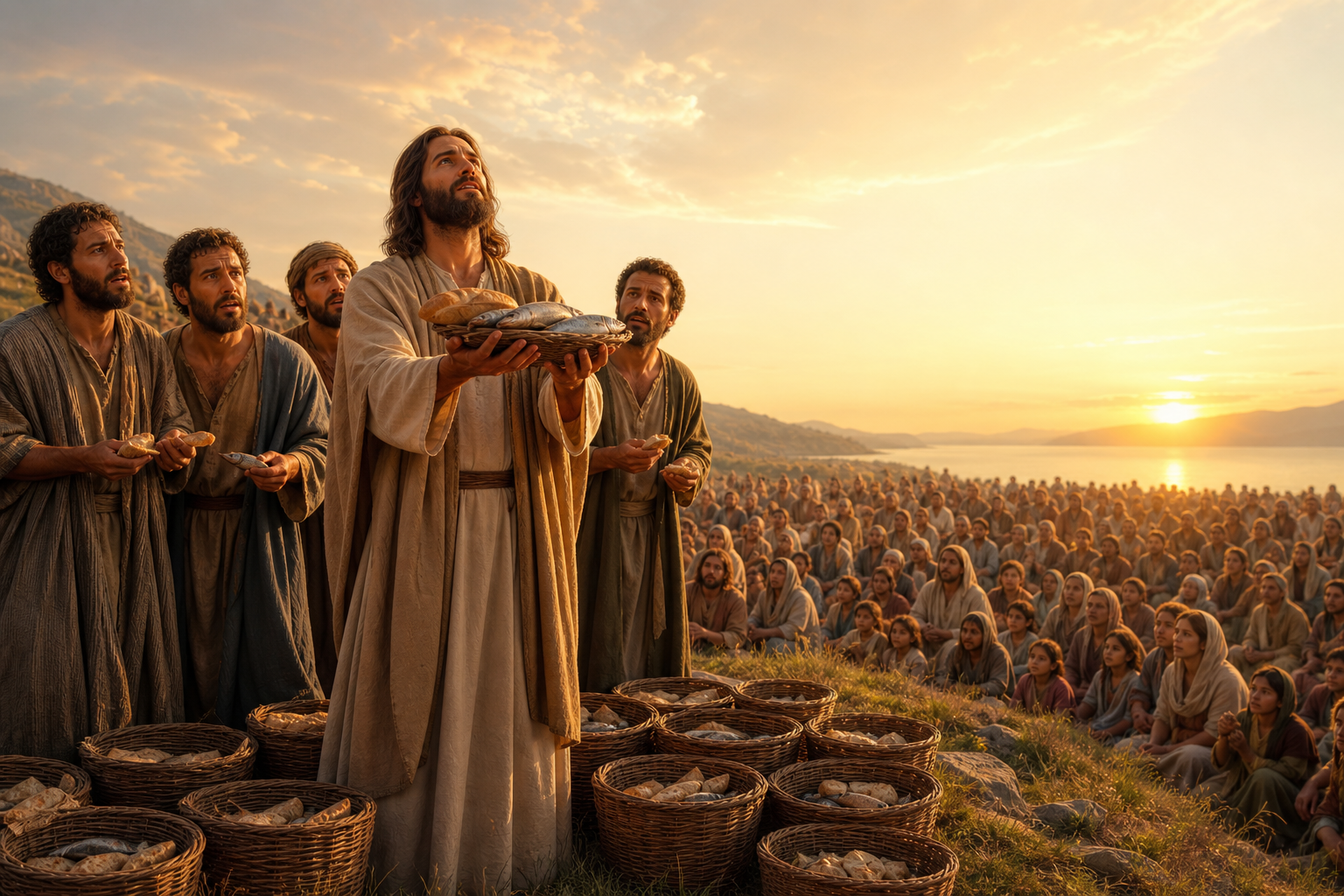
How much is a talent? Most scholars put it at around 15 to 20 years of a laborer’s wages. That is what the master puts in the hands of his servants. One word comes to mind: trust. Who would you entrust with roughly a million dollars while you are away?
The Lord does. He has entrusted you with a talent, or talents. He called you to faith. He trusts that, as part of His Kingdom, you can manage what He has given in order to bear fruit for it: faithfulness in using God’s good gifts.
Three observations from Lenski’s commentary help us to see more details about Jesus’ teaching.
The same praise goes to the five-talent and two-talent servants (vv. 22–23). What decides our place, Lenski says, is the faithfulness we show with whatever we were given, not how much we were given. He also notes that the first servant “went immediately”: the faithful one didn’t wait for the right time.
“Lord, five talents you gave me” (v. 20). The faithful servant opens his report by acknowledging the gift. Behind joy in faithful work, Lenski says, stands confidence in what Christ has accomplished for us, and that confidence also motivates the work. Our assurance rests in Christ, not in our usefulness.
The servant’s own logic doesn’t hold together (vv. 26–27). If he really feared a hard master, burying the talent is the one thing that doesn’t follow. The bank would have been safer and less work. Lenski adds that the very least we can do is let others, who work on a larger scale, put our small gifts to use. Fear aimed at the wrong target ends up doing nothing. Hiding was never a safe option.
3 – No comparisons
Notice this about the parable: at no time are comparisons made. The servants don’t compare themselves with each other, and neither does the master. He holds the third servant accountable not by comparing him to the others, but by holding him to the standard of what he himself had received.
This shows that the master knew his servants and knew their ability. He should have thought, “If the master entrusted me with years of wages, he knows I can do it.”
So what do we do with today? We live as people whom the Lord trusts to manage the talents he gave us. The Lord knows you can do it. He is the one who called you to faith. He is the one who gave you Word, Baptism and the Holy Supper, the means by which grace comes to you.
Does that mean He expects you to speak in public, travel to other countries, or start a missionary movement? If you have been given that, use it. But what about small, steady, constant acts of a faith that is active in love?
- Contacting someone who’s been on your mind
- Being present with and for your family
- Helping your Church to carry out its work; bringing your offerings to support the mission.
- Sitting with someone in a hospital or care home
- Listening to a coworker or a neighbour who’s struggling
- Praying for someone by name
- Saying the thing you’ve been postponing (apology, thanks, a word of faith)
- Using a trade or skill: fixing, baking, driving, organizing, translating
Talents include “church skills,” but not only. Your talents are whatever God has put in your hands, including your job, your time, your home and your relationships. And one of the hardest is this: loving those who are near you. That is where most of your opportunities to use your talents usually are.
I read someone posting online that he or she felt tey were superior to other people, because she cared for the world, then for the country, then for the individual, while others do the other way around. This was supposed to be self-praise, but it is actually a self-own. If you can’ care for yourself and for those around you first, you will not do a better job in caring for abstract concepts as “the country” or “the World”.
Our love is concrete. Love God. Love our neighbour. Do you have five talents? Praise the Lord. Do you have three, two, one? Praise the Lord all the same. Use them as best you can. Keep in mind:
- If you are a Christian, you have received talents. Don’t think you’ve got nothing. The Master gave you faith, so He trusts you to carry on His mission. Don’t hide them.
- Use them to the best of your ability.
- You won’t be perfect. Forgiveness is available to you.
Our usefulness in the kingdom of God is not measured against others, but against what God has entrusted to us.
Now, some people have trouble reconciling the end of the parable with the love of God. I’ve read explanations that say this isn’t really God, because He is not a greedy master who wants his money at any cost and punishes those who don’t play by the logic of the financial world. Here’s where I address what the wrong image the third servant created that led him to the wrong attitude.
This parable is about the end times, the last day, when the Master comes back. That is a day of love and justice. Love that welcomes those who had oil for their lamps and whose faith showed itself in works. Justice for those who neglected the oil and became slothful. A blessed day for those in Christ. A terrible day for those without oil, with talents hidden in the earth.[1]
The third servant’s description of Jesus is not precise because it is a half-truth (Lenski, v. 24). The servant ignores what it cost Christ to make us His servants: His own blood. He ignores that every gift was freely given. Until the Master comes back, it is grace time. We are called to serve and love God, who loved us in Christ. When He comes, He will come in love and in justice. In His love, He will welcome those who remained in Christ. In His justice, He will judge those who were not in Christ.
Are we back to fear again? Not at all. Paul comforts us in the Epistle: “Whether we are awake or asleep, we may live with Him” (1 Thess 5:10). There is nothing more comforting than knowing that the Master who entrusts us with His talents is the same Master who sends His Holy Spirit to help us do the best with them.[2]
It is attributed to Luther to have said or written, “Even if I knew the world would end tomorrow, I would still plant my apple tree”. Even if he didn’t, the saying holds true. What do we do with today? We plant a tree, we tend to our family, we love our neighbour, we share the Gospel.
Conclusion – On May 19, 1780, the sky over New England went dark at midday. The Connecticut legislature was in session, and some members wanted to adjourn, believing it was Judgment Day. The story is told that Colonel Abraham Davenport said the Day of Judgment was either coming or it wasn’t. If it wasn’t, there was no reason to adjourn. If it was, he wanted to be found doing his duty, so he asked that candles be brought.[3]
What do we do with today? We keep the oil of faith, fed by the Spirit. We live in faithfulness waiting for the last day. But we light a candle today and carry on. We can share what has been entrusted to us. We can love the neighbour God has placed before us. We do not have to prove our worth. We do not have to compete with one another. And we do not have to control what tomorrow will bring.
Our assurance rests in Christ, not in our usefulness. Therefore we live with wisdom and faithfulness, living out His talents, until we see Him.
__________________________________
[1] Let’s be honest: fear can freeze us. But fear, the wrong type of fear of the Lord, comes from not knowing Him well. If the wrong description of God is given, the wrong attitudes towards Him will emerge. But the parable describes something else. The talents are only “few things,” and the reward is the Master’s own joy (v. 21). Everything we manage now is just a trial run. The reward, “enter into the joy of thy lord,” is the reality itself, past what the parable’s imagery can hold. He also notes that the long delay tests the faithful and gives the unfaithful a long time to repent.
[2]“Matthew 25,” Lenski’s Commentary on the New Testament, SermonIndex, accessed November 14, 2026, https://www.sermonindex.net/commentary/lenski/MAT/25.
[3] “Centuries after the event, studies of forests revealed the most likely cause.[6] The likely cause of the Dark Day was smoke from extensive forest fires, for which there is contemporary evidence. Researchers examining tree rings and fire scars in present-day Algonquin Provincial Park in Ontario, Canada, have identified a fire in 1780 and attribute the Dark Day to that” https://connectsci.au/wf/article/16/3/266/22965/Fire-scars-reveal-source-of-New-England-s-1780