Sermon – August 2nd, 2026
Hope Lutheran Church, Port Coquitlam BC
Text: Matthew 14:13-21
Theme: Wrapping our hearts around it
______________________________________
Introduction — (does a math puzzle and guesses the result)
What about that — did you figure out how I just read your mind? Seems impossible, and yet I just did. I bet you’re still sitting there trying to wrap your head around it.
Here’s an interesting idiom we have in English: “The idiom wrap one’s head around something means to understand something, especially something strange or out of the ordinary; to accept something that one does not particularly want to accept.”[1]
When we see, hear, or experience something we have a hard time wrapping our minds around, we have a hard time believing it and acknowledging it as reality. It means to understand something, especially something strange or out of the ordinary. It means to accept something you don’t particularly want to accept.
Well, prepare lots of wrapping there because I’ve got a couple of things from the reading today that may pose a big challenge to wrap your head or your mind around:
The Gospel – Jesus’ miracle
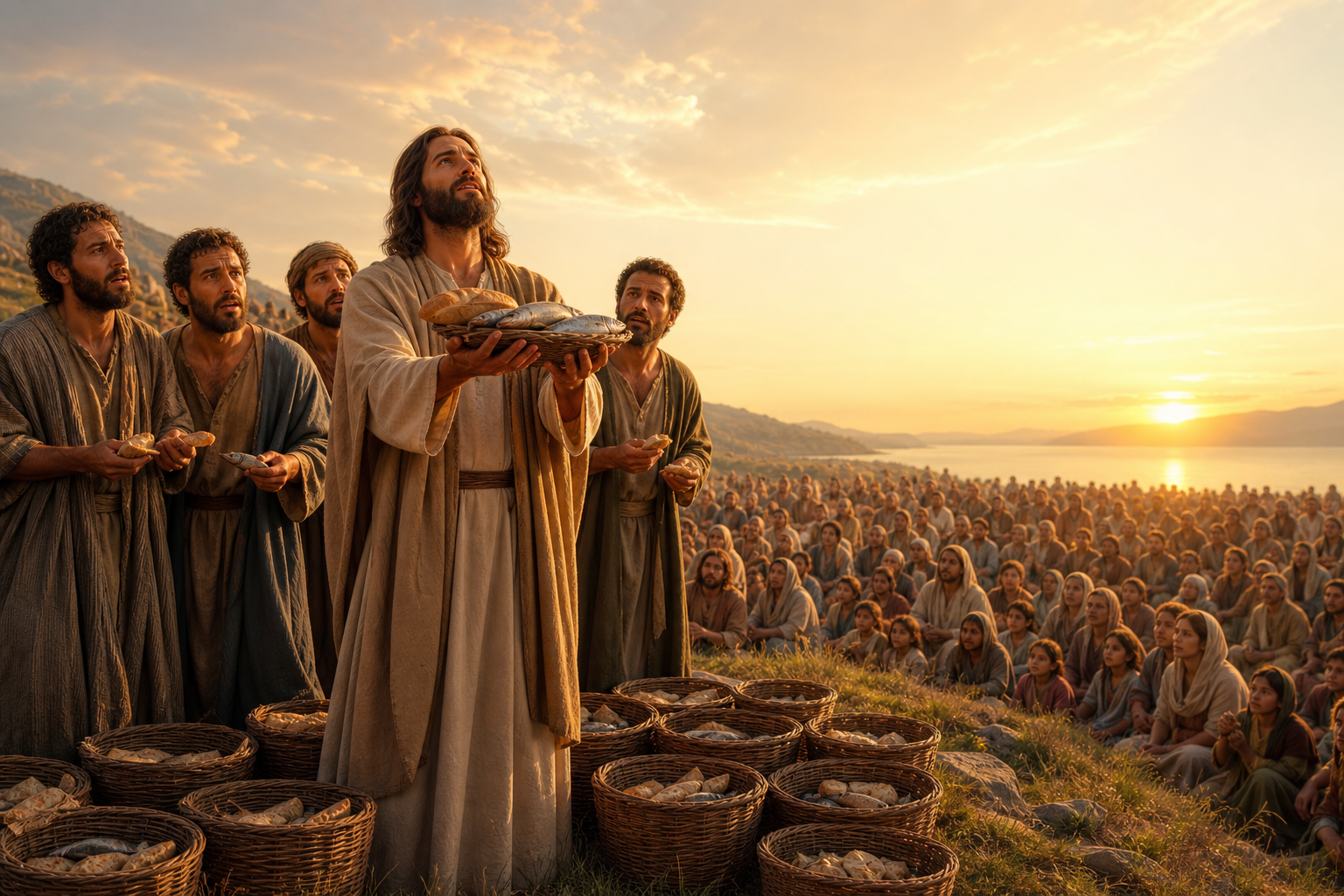
1.The multiplication. How do you make 5 loaves and two fish feed thousands? Twelve leftover baskets, one per disciple. Each of the Twelve personally carries back a full basket. It’s not just “there was extra”, but each of them holds physical proof, in his own hands, that Jesus provided more than enough.
2.The total number could climb up to 15,000–20,000 people. Matthew specifically notes “about five thousand men, besides women and children.” Count families in and the crowd Jesus fed from five loaves and two fish was almost certainly three or four times that number.
3.He does this right after hearing His cousin was beheaded. Matthew 14 opens with the death of John the Baptist. Jesus withdraws to grieve — and the crowds follow anyway. He doesn’t send them away for interrupting His grief; He has compassion for them first, then feeds them.[2]
Romans 9 – Israel is the chosen people of God. But not only blood. Israel in the New Testament is the people of God who are in Christ, by faith.
“But it is not as though the word of God has failed. For not all who are descended from Israel belong to Israel, 7 and not all are children of Abraham because they are his offspring, but “Through Isaac shall your offspring be named. 8 This means that it is not the children of the flesh who are the children of God, but the children of the promise are counted as offspring”
Salvation is not a choice. At least not on your part. Salvation is a gift given to you. It was a gift given to Israel, the people of God of the Old Testament. It continues to be a gift to the Israel of the New Testament – The Church.
You belong to God’s Israel by faith in Christ. God knew you in eternity and has chosen you to belong to Him. That’s a lot for our poor, limited minds!
Isaiah 55 – “and he who has no money, come, buy and eat! Come, buy wine and milk without money and without price.” Very hard to wrap our heads around this one. We are very used to “there’s no such thing as free lunch”. Because this holds true to economics, we think it should be the same when it comes to spirituality. There must be something we need to do, nothing in life is easy.
Psalm 136 – Things keep getting harder to wrap our heads around. “His love endures forever”. “He created the heavens, the earth, the sun, the moon”… Almost every verse of the Psalm is currently challenged by heads and minds seeking for alternative explanations for what the Bible lays rather clearly and directly out.[3]
So many episodes and teachings of the Bible make it hard to wrap our heads around them that one may wonder if they’re true. The, because of that, many resort to the next option: to reach for rational explanations to satisfy their minds — “maybe that’s just a figurative way of saying how much Jesus cares for our needs.” Do we have means to prove that they actually took place as literally described? How can one guarantee it?
These texts bring one common problem: they all ask us to accept something our minds don’t want to.
The disciples’ solution
You see, in the Gospel, the disciples were also trying to wrap their heads around the situation. A huge crowd, late in the day, nothing to eat. And their solution made perfect sense: “Send them away.” Let someone else deal with it. Let them figure it out on their own. That is how our minds work too. When something is too big, too much, too impossible, we look for a reasonable way out.
Now, notice before whom they are offering that reasonable-sounding solution. Who are they standing in front of when they say it? Jesus, God in person.
Imagine talking to a cellphone expert and saying, “You know, my screen isn’t working — I guess I’ll have to call someone.”
Imagine parking in front of the best mechanic in the city and saying, “My car won’t start, I think I’ll have to find someone to fix it.”
Imagine standing in front of one of our own handymen, looking at a broken doorknob, and saying, “I think I’ll just leave it — there’s no one here who can fix it.”
The disciples are standing right in front of Jesus, and they still think they know better. Let someone else deal with it.
Is this how our minds work too? When something is too big, too much, too impossible, we look for a reasonable way out. When we’re in the pit of a spiritual struggle, we wonder how we’ll ever find peace. When we’re navigating trouble, we look for help and strength somewhere else. When we think about life and death, we wonder what happens after we die, and we go looking for an answer anywhere but the One standing right in front of us.[4]
Look to who is right in front of you
Can we wrap our heads around all of this, and everything else found in the Bible though?
We could try, but we would never have enough wrapping. At some point, we’d stop trying — because it runs straight into the sin and old nature in us.
The answer is not the mind, but the heart. We want to wrap our hearts around it. What is confusing for the mind can be accepted and believed in the heart by faith. This is the essence of Christian faith: to believe in our hearts and confess with our mouth that Christ is the Messiah, the offspring of Israel according to His human nature, who came to win forgiveness and multiply it in our lives.
Look to who is right in front of you: Jesus.
Jesus does not send people away. He brings them closer. He places what little is there into His hands, looks up to heaven, and then… He provides. Not just enough, but more than enough.
If you find yourself struggling to make sense of it all, you are not alone. The mind keeps asking: How? Why? Can this really be? The answer lies in one word: faith. The same Jesus who fed the five thousand is the One who now feeds you through faith. He gives not just with bread for the body, but with His very self for your salvation. His Word, His promises, His body and blood given to you. This happens not because we have figured it out, but because He is faithful.[5]
This is not a matter of trying to fit everything inside the limited frame of our minds. It’s a matter of receiving it first, by faith, in our hearts. Do we still use our minds in the process? No doubt we do. But when our minds are guided by God’s Word, our hearts are wrapped around the content that leads us to understand way more than what our reason ever thought possible.[6]
Conclusion — (the answer to the puzzle) Now you can wrap your head around what I did. It has a rational explanation. But remember: when it comes to faith, the most important thing is to wrap your heart around Jesus’ Word. Believe Him. Trust Him. For no matter the puzzle may lay ahead of you, He wraps His arms around your life, to assure you of His providence, Grace and love.
_____________________________________________
[1] The expression wrap one’s head around something is also expressed as wrap one’s mind around something and the earliest known version, get one’s head around something https://grammarist.com/usage/wrap-ones-head-around/
[2]It’s the only miracle in all four Gospels. Every other miracle Jesus performs appears in at most two or three of the Gospels — this one is in Matthew, Mark, Luke, and John. The early church clearly saw something in this event too significant to leave out, no matter which Gospel they were writing.
[3] This takes us to beyond what we can comfortably understand. Because we are used to limits. We are used to earning, buying, deserving. “There’s no such thing as a free lunch,” we say—and that works well in life. But then comes the Word of God: “Come, buy and eat… without money and without price.” Now that is hard to wrap our heads around. Because it means grace is not a transaction. It is a gift. It means forgiveness is not something you work toward, but something Christ gives freely, abundantly, like bread multiplied in the wilderness.
[4] We are used to limits. We are used to earning, buying, deserving. “There’s no such thing as a free lunch,” we say — and that works well in life. But then comes the Word of God: “Come, buy and eat… without money and without price.” Now that is hard to wrap our heads around. Because it means grace is not a transaction. It is a gift. It means forgiveness is not something you work toward, but something Christ gives freely, abundantly — like bread multiplied in the wilderness.
[5] Jesus is here, right in front of you. In His Word taught, preached, proclaimed. Inn bread and wine, His body and blood, given to be received in repentance and faith, for the forgiveness of sins and life everlasting.
[6] This is important. Jesus didn’t give food to people every day. He didn’t heal every sick person in the area. He did those things here and there, to confirm with signs and wonders that He was the One. But forgiveness, salvation, and peace — those He extends to every single head and heart, every single person.
Image generated by an AI LLM