
Sermon – July 26, 2026
Hope Lutheran Church, Port Coquitlam BC
Matthew 13:44-52
Theme: “On treasure and Trust”
___________________________
Intr – “Love people and use things; not the other way around.” We’ve all probably heard, or said, that before. It shows up in books, conversations, and social media quotes. And it gets repeated so often because of course that’s true.
I’m thinking about this saying today because Jesus approaches the topic of treasure and heart in the Gospel today. Parables pointing to investing all one has in the things one considers a treasure. So, when it comes to pointing to what is the biggest treasure in our life, it seems to be a no-brainer. People. Things we use. People we love and treasure.
Yeah…but if we’re honest, walking the talk on that one is a problem for every one of us. You and I live in a world of things that challenge our use of time, attention and investment. For example: Cell phones in our hands; Cars in our driveways; Busy weekly schedules; Trips we plan; and now AI, posing an ultimate challenge to how we use things and how we see people.[1]
The Gospel goes deeper. Jesus addresses the tension in our hearts about treasure and trust that is not just about people and things. It is about Persons. It is about God Himself. Jesus says, “Where your treasure is, there your heart will be also.” In other words: show me your treasure, and I’ll show you your trust. Where does our heart rest when it comes to unconditional trust?
The parables
Jesus knows how our hearts work, how easily we get attached to the wrong treasures. The world, the devil and our own sinful desires drive us away from Him and towards things we can see, click, count in figures or control. He knows how easily we trade the eternal treasure for the ephemeral treasure of our present time.
So I don’t think it’s an accident that, in Matthew 13, we get four images in a row circling back to the same theme: treasure, value, worth.
Let’s have a look:
- Hidden treasure in a field(v.44): The man who finds the treasure in the field goes and sells everything he has so that he can buy that field.
- A pearl of great price (vv 45-46): — he’s a professional. He knows pearls. He has spent his life searching for exactly this. And when he finally finds the one pearl that surpasses everything else he’s ever seen, his response is identical to the farmer’s: he sells it all.
One man finds treasure by surprise. The other finds it after a long search. But both of them respond the same way — total, joyful sacrifice for the sake of one thing of supreme worth. [2]
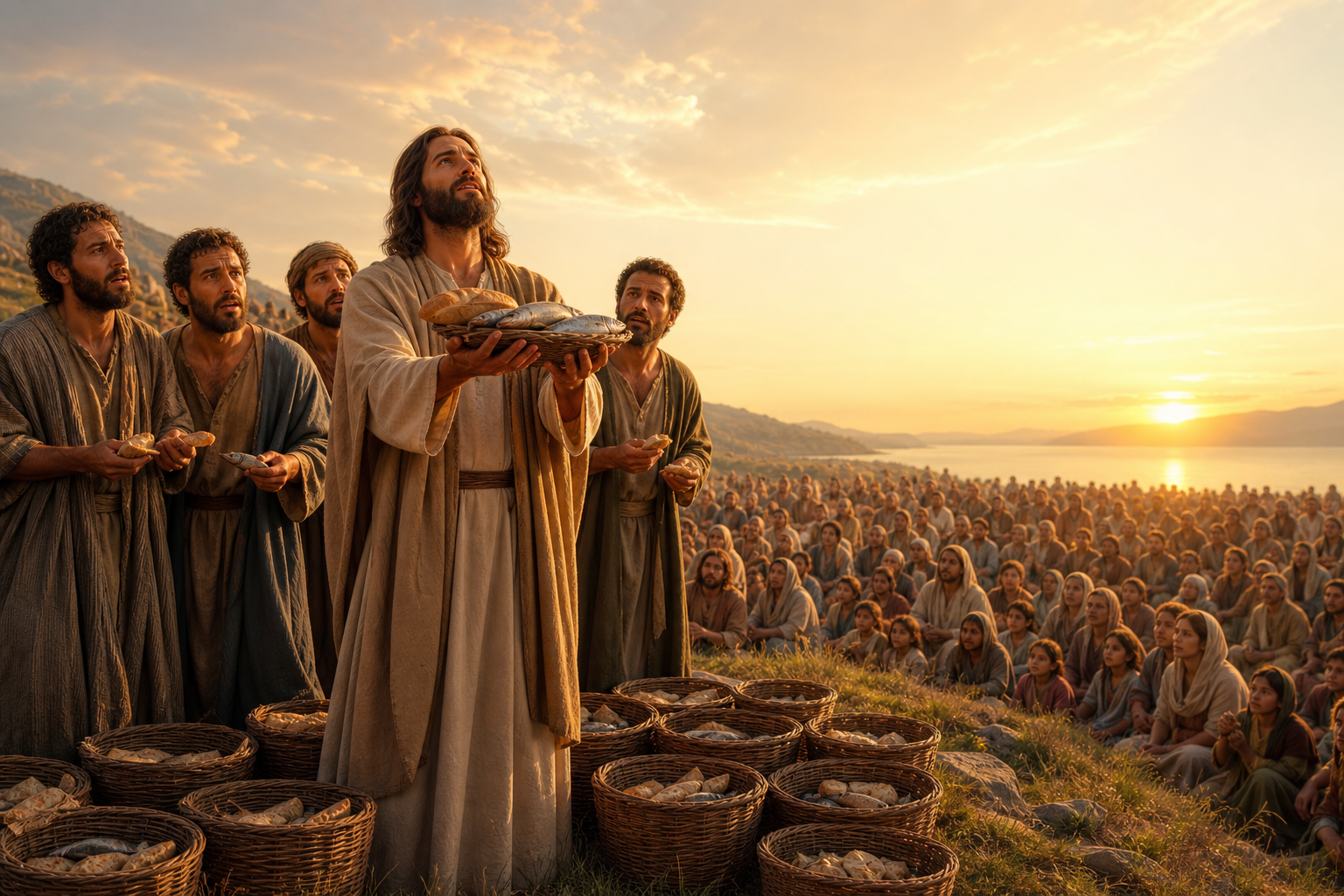
- A net full of fish (vv. 47-50)—enough fish to be a year or more of wages.[3]
That net catches everything — good and bad alike — and only at the shore does the sorting happen. Where our tresure is in life indicates what happens at the end of life.
Jesus starts with things (fish, nets, wages), but He ends with people and eternity.
“Have you understood all this?”
“Have you understood all this?” Jesus asks. “Yes,” the disciples say. Have they, though? Really? These are the same disciples who, just chapters later, will argue about who among them is the greatest; will fall asleep in the garden when Jesus needs them most; will scatter when things get hard. They said yes.
Just like us. I’m sure we understood the meaning of Jesus’ saying. But surely, we will still stumble and fall.
This world full of treasures that seem more visible, palpable and valuable, tempts our hearts away from Him. We praise Him on Sunday, but the week is sometimes filled with treasures that so not match the worth stated in God’s Word. Sometimes we will care more about our things than about people.
You know: Things feel safer. Things don’t argue. Things don’t betray. Things don’t bring their own history, trauma, complexity, and sin into the room. People do.
Some AI tools in particular has become a big temptation. They are patient in a way people rarely are. It doesn’t get tired of us, doesn’t need anything back, doesn’t carry its own history into the room. Yes, it is not always easy to prioritize people over things. We say “family first,” “relationship first,” but then we are exhausted, it’s easier to reach for the things that keep us in our world that to the conversation that drives us to the other person’s heart and head space.
That’s the word that accuses us. But what’s the Word which comforts and strengthens our faith?
Here’s what Jesus is pointing us to:
First of all, Jesus points us to God Himself—Father, Son, and Holy Spirit. The Kingdom of Heaven, the presence and rule of Christ. That is the real treasure. That is the One thing worth losing everything else for. We belong to the Kingdom that has no end.
But here’s another special, comforting angle to these parables: there is a long Christian tradition to teach these parables this way: that Jesus is the One who gives everything to purchase the field, to claim the treasure, to obtain the pearl. In other words, He sees us as treasure. He counts us worth His life. Yes, one of the most special answers to the question “who is the treasure, really” in these parables is this: It’s You and me. We are the treasure.
Think about who, in all of Scripture, actually does what these parables describe — someone who sells everything, holding nothing back, to obtain something of supreme worth. There’s really only one. Paul writes in Philippians that Christ, though he was in very nature God, emptied himself — gave up his glory, his rightful place, ultimately his own life on a cross. He held nothing back. He sold it all. To obtain what? You. Me. Us. The Church. Sinners, every one.
From this perspective, the treasure hidden in the field, the pearl the merchant spent his whole life searching for — it’s people. It’s you. People are more important than things. For Jesus. For you and me.
In Christ, the treasure runs both directions. He gives up everything to gain us — and what he gives back to us, in return, is himself. We’re not just handed a prize and sent on our way. We’re connected to the relationship that has existed eternally between the Father, the Son, and the Spirit — adopted into that family, brought into that love. That communion, that belonging, is the treasure beyond price.
And when that starts to sink in—when we see that we have been treasured by God—that’s when our own attachments begin to loosen. Then the car, the trip, the phone, the technology, even AI, they can stay in their proper place. They can become tools again. Good tools. Helpful tools. Tools to serve people instead of replacing them.
People are more important than things because that is How Christ sees us. We reflect His love for people by loving people. In Christ we are people who have already been loved by the One who gave up everything for us. He found His treasure—and it was you.
Jesus closes with one more image: “Every teacher of the law who has been instructed about the kingdom of heaven is like the owner of a house who brings out of his storeroom new treasures as well as old.” This is the beauty of God’s Word, Old and New Testaments, giving us the whole counsel of God.[4]
Old and New Treasure
Jesus doesn’t simply say, “Try harder to trust Me.” He first shows us His trust. He is the One who leaves the glory of heaven, takes on flesh, walks among us, suffers, dies, and rises.
And in that, He reveals both our treasure and our trust:
- Our treasure is Christ and His Kingdom.
- Our trust is in the One who has already trusted the Father perfectly on our behalf.
Jesus does something beautiful here: He tells stories about treasure, but He is talking about about people. And about Himself. Jesus is teaching what it really means to love people, use things, not the other way around.
This may be a world obsessed with things. But our good news is this: You belong to a God who doesn’t just use people and discard them. You belong to a Savior who Himself became a person, the most important person ever. That person, God and Man, Jesus, gave everything for you, treasures you, calls you into a Kingdom where people matter more than possessions, where the greatest wealth is to know Him and to be known by Him. “The Kingdom of Heaven is like a treasure.” And in the eyes of that King, you are His treasure too.
Conclusion – Love people, use things — not the other way around. That’s not just good advice anymore. It’s the shape of a the Christian life. People who trust that they have already been loved and treasured first.
________________________________
[1] The point is not to say that phones or AI are evil. They are gifts, tools, blessings. But one of the challenges they present is that they quietly invite us to trust them—to depend on them to build our sense of security, comfort and even identity.
[2] The Kingdom is worth more than anything else. But we can also hear it the other way: Christ is the One who gives up everything for the treasure He sees, His people. He is the One who joyfully pays the cost to make us His own. Either way, the message is clear: when the true treasure is in front of you, everything else moves down the list.
[3]Think about the size of that catch: for fishermen, a net “full of fish” means food, income, survival—maybe a year’s worth of wages. That’s serious value. But even that enormous catch is not the real point. Jesus is pointing to something bigger:
- The final sorting
- The reality that there will be a separation
- That there is a serious, eternal dimension to what we treasure and how we live.
[4] Beyond that, we are also reminded that we don’t ditch the Word because of any new spiritual fad. We also don’t ditch something new, from our time, if that is useful to share with people the love of God.