Matthew 9:35-38
Theme: “Sheep with a Shepherd”
___________________________
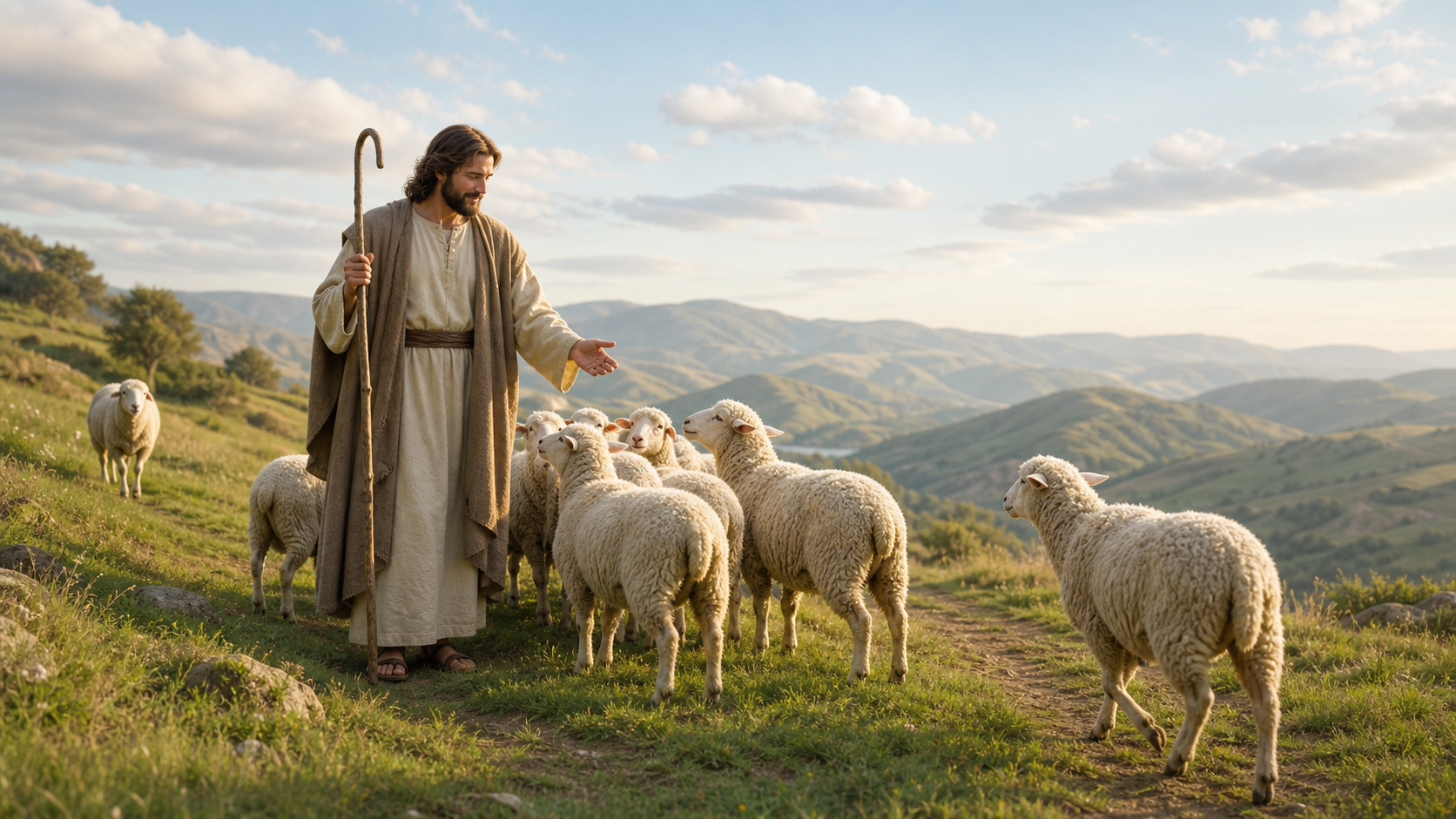
Intr – Here’s one thing that stood out in the Gospel to me: as Jesus looked at the people, he says that they were “like sheep without a Shepherd.”
How could Jesus say that? I mean, look at how many spiritual leaders they could rely on: priests, rabbis, scribes, pharisees—just to quote a few. It seems that an excess, not a lack of Shepherds, would be the case here.
But Jesus has a point, and it is not about numbers. He has compassion on the people without a shepherd because most of the Shepherds available at the time were not preaching the pure Word of God. They were feeding them a version of faith that had, in many ways, departed from God’s Law. We could put it this way: many things that were good, they called bad. And other things, which were bad, were called good.
Just a few examples:
- Jesus as the Messiah – Bad. He is just another false prophet that must be silenced.
- Faith reduced to rule-keeping – Good. This is how you make sure you are pleasing Yahweh, our God.
- Eating with sinners – Bad. How come he doesn’t keep limits and boundaries between pure and impure people?
- Rituals elevated over mercy – Good. You must fulfill all your religious obligations, even if only in a perfunctory way.
And so on. When we read through the Gospels, especially St. John, we realize what type of “shepherds” they had. The religious leadership of Israel had the tendency of focusing always more on exterior things, like ceremonials, rituals, unending lists of commandments and duties; the interior of the people, their hearts, was not being properly nourished then. The food was there – the Scriptures -, but it was not being properly prepared and served. [1]
People were then left trying to make sense of that theological confusion. They were not being fed green pastures and still waters. Thus, they would either be skeptical and looking for the material blessings Jesus offered; or feeling anxious, burdened, worn out.
Can we say the same about our day and time? We can, in many respects. When we look around, we see many spiritual leaders, guides, influencers trying to help people in their spiritual journey. There are lots of shepherds, be it Christians or from other ideologies around us offering greener pastures and fresher waters, ideas and ideologies. It could be said that we, too, have more shepherds than we know what to do with.
Here we have some contemporary examples too:
- Talking about sin and guilt – Bad. People need to be free from these things and be free to pursue the best version of themselves.
- Every good thing you do comes back to you – Good. That’s the law of attraction and the law of return.
- Teaching the Cross and suffering – Bad. People need to hear a positive message.
- If you don’t steal, don’t kill, are kind and pay your bills, you are a good person – Good. This is how you become a good person before God.
Another example: just the other day, a clip went viral of an American congressman, supposedly Christian, saying that nowhere in the Bible Jesus asks us to worship him, but only to follow him. This is a declaration that does not match the teaching of Scriptures. And yet it was said with confidence, publicly, as if it were a reasonable reading of Scripture.
Heresy doesn’t always show up as such. It may sound reasonable; it may sound kind. It may sound like it is making faith more accessible, more relevant, more comfortable. But what it is usually doing is avoiding healthy interpretation of Scriptures. Avoiding calling things what they are.
And that avoidance leaves people exactly where the crowds in Matthew 9 were. Confused, helpless, without a true shepherd who tells them the truth.
Now, if you step back and look at every form of spirituality, they all fall into one of two categories: you have a bill to pay, something to prove, a standard to meet. Or your bill has already been paid. The debt is real—but it has been settled, not by you, but by grace.
Enter the True Shepherd. Jesus is the only one who stands in that second category. He is the Shepherd who has paid your debt in full—on the cross, for you.
That is what many shepherds of every era get wrong. They keep bringing the bill back to you. In one way or the other, you will hear that you owe something, that you need to perform, at least a little bit. Which means, your standing before God has some connection with what you do.
Chances are that people will walk away from those shepherds either proud or exhausted.
Our world needs The True Shepherd. The world needs Him whose voice calls things what they are and calls people into the family of faith. Jesus is that Shepherd; our Shepherd. While those people were like sheep without a Shepherd, we are sheep of the Shepherd. Jesus.
He came to provide His sheep with their deepest need: forgiveness. In Him your sins are forgiven. Not in part, but completely. Not because of rule-keeping, but because of Him who keeps you in the faith. He guides. He leads. He gives us new life.
And in Him we learn to call things what they are, not what the world wants them to be.
-Our brokenness is real. We don’t need to sugar coat it with “everyone is imperfect”. “I am a victim of my circumstances”, “I got to be strong”. “if I admit I am weak no one will respect me”.
-This brokenness doesn’t need to be elaborated, dismissed or hidden. It can be confessed, for it can be healed. For free.
-The Shepherd forgives our sins, gives us a new life and empowers us to live faith in our daily vocation.
-The Shepherd Calls us to worship him, learn from Him, follow Him. He calls us to live our lives in Him.
Sheep today still need to hear this voice, The Voice of the Good Shepherd. The One who calls things what they are. The Father who offered His Son to die for you, so that you don’t perish, so that you have eternal life.
Remember also that this is not just about hearing. It is also about living and sharing the Word of the Shepherd. We are encouraged to call things what they are. What God calls bad, we don’t say it’s good. What God calls good, we will hold as such, preach, teach and live in our lives.
That’s why we need labourers. In the text, we see Jesus praying for more labourers. It includes ordained ministers for sure, but not only them. It includes royal priests[2], you and I. We are called to work in God’s kingdom, starting in our own neighbourhood.
Does that mean we will have to make the seed germinate and grow? No. Jesus is asking for people to reap the fruits that God provides. We don’t grow the harvest. We don’t make faith germinate in someone else’s heart. The Lord prepares the hearts; we are sent to gather them in by speaking His truth.
Cc – One last thought about the Gospel. People came to Jesus with lots of interests in mind. Some of them, unfortunately, only for free food and free health.
In your life, many people have many interests in you. Your money, your company, your position… Jesus, however, has interest in YOU. Full stop. You’ve got nothing to offer him, and He still is compassionate toward you. You are a sheep who have a Shepherd. You know His Voice and His Word. Don’t trade it for any other offer of spirituality. Stay with the One who calls things what they are.
He is the Shepherd who paid your Bill – so your heart has peace, your mind has direction and your life has salvation.
________________________________
[1] Lenski, p. 382.
[2] 1 Peter 2:9