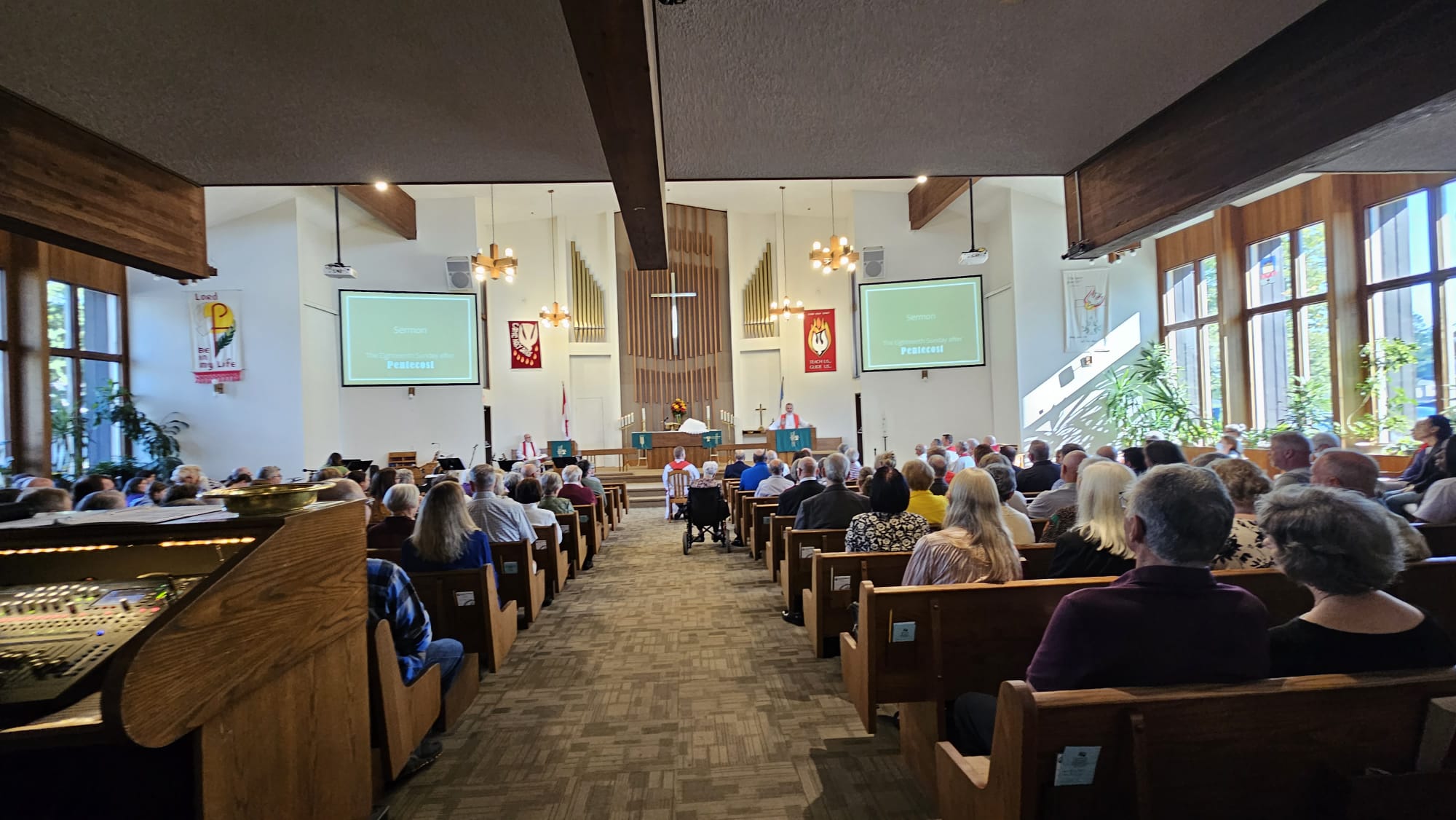
Hope Lutheran Church, Port Coquitlam BC
Matthew 3:13-17; Romans 6:1-11
Theme: “This is the One (The Voice from Heaven speaks)”
___________________________
Introduction – Let me start by addressing possible questions about why Jesus needed to be Baptized. It is the Baptism of our Lord Sunday, and whether if you are new to faith or if you have been a Christian for a long time, you may still stumble on explaining why Jesus needed to get Baptized.
The answer is: He didn’t—not for himself. He did it for us. Just as he didn’t need to die, least of all on a cross like a criminal. But He did for us of love, to show that “he became sin who knew no sin so that we might become the righteousness of God.”
Jesus had no sin to confess. But he came to fulfill all righteousness in our place, to identify completely with sinners he came to save. John’s baptism prepared people for the Messiah; Jesus’ baptism would later connect us to his death and resurrection, delivering forgiveness, life, and salvation.[1]
Jesus begins His ministry showing He is not just one more of the prophets – But The Prophet, the Messiah. Here he shows His two natures: He comes as a man to identify with sinners. He comes as God as we see the presence of the Father and of the Holy Spirit. Jesus gets baptized not because he had sin, but because he identifies with sinners, whom He loves, saves and gives eternal life.
Here’s another reason: it gave occasion for the Holy Trinity to be manifested and for the Father to point to Jesus and say, “This is my beloved Son”. This is the One. The wait is over. The Messiah, Jesus Christ is here.
Now, right after Jesus comes out of the water, the heavens open, and a Voice speaks: “This is my beloved Son, with whom I am well pleased.”
The Father Himself speaks. And his voice is heard. It is:
- Precise – It points clearly to Jesus.
- Definitive – “This IS my beloved Son.”
- Declarative – “With whom I am well pleased.”
The Father points His finger at Him and says: “This is the One.” In a world full of conflicting messages and “personal realities,” God provides the One true reality: His Son made flesh, identifying with Sinners to save them.[2]
The Problem: Which Voice?
That mattered because people were surrounded by voices of different prophets. Teachers and “messiahs.” Conflicting hopes and expectations. Which voice should they trust?
And not much has changed. We still live surrounded by voices telling us who God is, what matters, and what is true.[3] We are told that meaning depends on how you hear something, that truth is personal, that your interpretation is what counts.
The worst part of it? It created a culture in which you are primed not to hear or see reality but your own reality. Reality is what you believe.
Let me show you and example of how that works. I’m going to play a short audio clip of a crowd chanting. Just listen. (Play audio) What did you hear? Let’s listen again. (Play again)
It’s the same recording, the same sound waves, but people often hear completely different words. Since all the options for the audio seem to be valid, it appears that they are all true, right? It doesn’t take long before someone utilizes this example to say, “See? There’s no single or absolute meaning to things. It’s all interpretation. What matters is what you hear.” There’s actually even a video of a professor utilizing this audio to make this point: You don’t see or hear reality, but only your reality.[4]
How does that show up in the world?
“Your truth is your truth”
“There is no absolute truth”
“This relationship feels right to me, so it must be right.”
“This choice makes me happy, so God must be okay with it.”
“That belief works for you, this belief works for me.”
“No one can tell me what’s true for my life.”
How does that happen in the church? Examples
“I know what it says, but I experience it differently.”
“That may have been true back then, but this is how I hear it today.”
“This is what this Bible passage means to me.”
It can affect teaching too, for example, when one insists that Immersion Baptism is the only valid form of Baptism.[5]
The truth about Truth
This conversation can be summed up in the popular saying: “What does this text mean to me?” Like with that audio sample. “What does it say to my ears?”
But it misses one obvious thing: Who exactly Jesus is and what He says is available to be checked, learned and trusted. You can learn exactly who He is.
The same with that audio, if someone wants to use it to prove that many things can be true at the same time. They can’t. Because you can go to the source and discover what the original recording actually says. And that settles the matter.
No matter what you hear, if it’s not what was recorded, then it is not true. You ask the person who recorded it. They know. They know the exact words that were recorded so, even if someone brings up a different interpretation, “their reality”, you can confront them with reality itself. Here this is what was recorded; there is no other meaning to these words.
We don’t need to find our own reality; we need to be confronted by the reality. When we want to cut through the noise, we go back to the One who spoke. We go to the Recorded Voice: The Word of God. [6] At Jesus’ baptism, God Himself speaks. He does not offer a suggestion. He does not invite interpretation. He declares reality. “This is my beloved Son.” Not “a son.” Not “someone meaningful.” Not “your version of a good teacher.” This is my Son.
And that voice has not disappeared. It has been recorded for us. In the Scriptures that point us to Christ and His cross. In Absolution, where forgiveness is spoken, not implied. In the Sacraments, where God attaches His Word to visible promises. God has spoken, and He has told us exactly who Jesus is.
We have the recorded voice of God in His Word. There we find the answer that helps to hear his clear voice. He tells us who He is. And because we have the ‘recorded voice’ of the whole Bible, we know that identifying Him as the Son is an invitation to listen to everything He is about to do and say. For God doesn’t suggest possibilities. He speaks with the clear voice of Scripture.
Your Baptism = That Same Voice Over You
This is deeply personal. Paul tells us in Romans 6 that we were buried with Christ by baptism into death, so that we might be raised with Him to new life. That means your baptism was not just a ceremony. It was not just water. It was not just something that happened in the past. At your Baptism, God spoke. Just as surely as He said, “This is my Son.” In Baptism, God used that same voice over you: “This is my child.”
This declaration does not depend on how you feel. Because some days you feel faithful. Some days you feel doubtful. Some days your thoughts are nothing but noise. But the truth of your Baptism does not depend on your clarity. It depends on God’s voice. And God’s voice does not change.
When the noise gets loud in your week, remember: God has already spoken over you. The voice of heaven has been recorded.
- In the Scriptures that point us to Christ and His work on His Cross.
- In the waters of Baptism, where God attaches His Word to a promise
- In Absolution, where forgiveness is not implied but spoken
- In the Supper, where Christ does not say, “Think of this,” but “This is my body… this is my blood”
In faith you receive the benefit of His work on His Cross. You are redeemed and you are headed toward eternal life. That is not interpretation. That is declaration. You may feel unchanged some days. You may hear only noise in your own head. But the meaning of your Baptism does not depend on your clarity. It depends on God’s voice.
Conclusion – I did my homework and looked up what is exaclty said in that viral audio clip. Here it is (The chant actually says only one thing: “That is embarrassing.”)[7] It is used by soccer fans in Derby County, England, to mock adversaries when they make a mistake. Now, once you know that, you can’t unhear it.
In the same way, once you know that God has spoken over you, that truth doesn’t fade when life gets loud. This week, when competing voices press in, remember this: God has already spoken. He has declared who Jesus is. The begining of a new year is a good time to re-calibrate our ears and tune them in to the voice of the Father. He has declared who you are.
Don’t trust the noise. Trust the voice that speaks truth. This is the One. Amen.
_________________________________________
[1]-John’s Baptism is still limited to the Jews. John’s baptism was for repentance and forgiveness, preparing people for the Messiah. That is the meaning of the Word Baptizein in Greek – to wash with water, in this case, in a sacred ritual. John’s baptism was a baptism of repentance pointing forward to the coming Messiah. Jesus’ baptism in Matthew 28 connects us to his death and resurrection and delivers forgiveness, life, and salvation.
[2] “Now, the Voice from heaven came right after Jesus came up from the water. It is the Voice of the Father pointing directly to the Son. While the explicit command ‘Listen to Him’ comes a bit later in Matthew’s Gospel at the Transfiguration, the message here at the Jordan is the identical foundation: This is the One. By declaring Jesus as His ‘Beloved Son,’ the Father is establishing Jesus as the ultimate authority. It’s as if the Father is clearing the air of all other noise and saying, ‘This is the Source. From this moment on, if you want to know my heart, you look at Him. If you want to hear my truth, you listen to Him.’
[3] Later in the Gospels, we see that when God speaks, some people perceive it differently. Some hear thunder. Others think an angel spoke. Even between the three Gospels’ account there’s a slight difference in wording, “You are my beloved Son” and “This is my beloved Son”.
[4] Here’s the thing: for once, that’s partially fair. Sometimes we do mishear things. Sometimes our own perspectives color what we think we’ve heard. Context matters. Background noise interferes. We don’t always hear clearly. We are constantly bombarded by voices—social media gurus, cultural experts, and our own anxious thoughts—telling us who we should be or what God is like.
[5] And there is still the opposite – the argument of silence. “Jesus never spoke against it, so he must be okay with it”
[6] As we perk our ears to the clear and correct teaching of the Scriptures we are assured that we are hearing God’s Voice. For example, in the readings for today:
_Isaiah 42: 2 “I have put my Spirit upon him; he will bring forth justice to the nations.” / 6 “I am the Lord; I have called you in righteousness; I will take you by the hand and keep you;
_Romans 6: 4 We were buried therefore with him by baptism into death, in order that, just as Christ was raised from the dead by the glory of the Father, we too might walk in newness of life” / 11 So you also must consider yourselves dead to sin and alive to God in Christ Jesus.
By the way, what is this newness of life Paul talks about. It is new compared to what? Compared to the oldness of life. Sin is the old life, Christ is the new one. We are dead for sin and alive for Christ. Paul talks about it in the context of Sin and Grace.