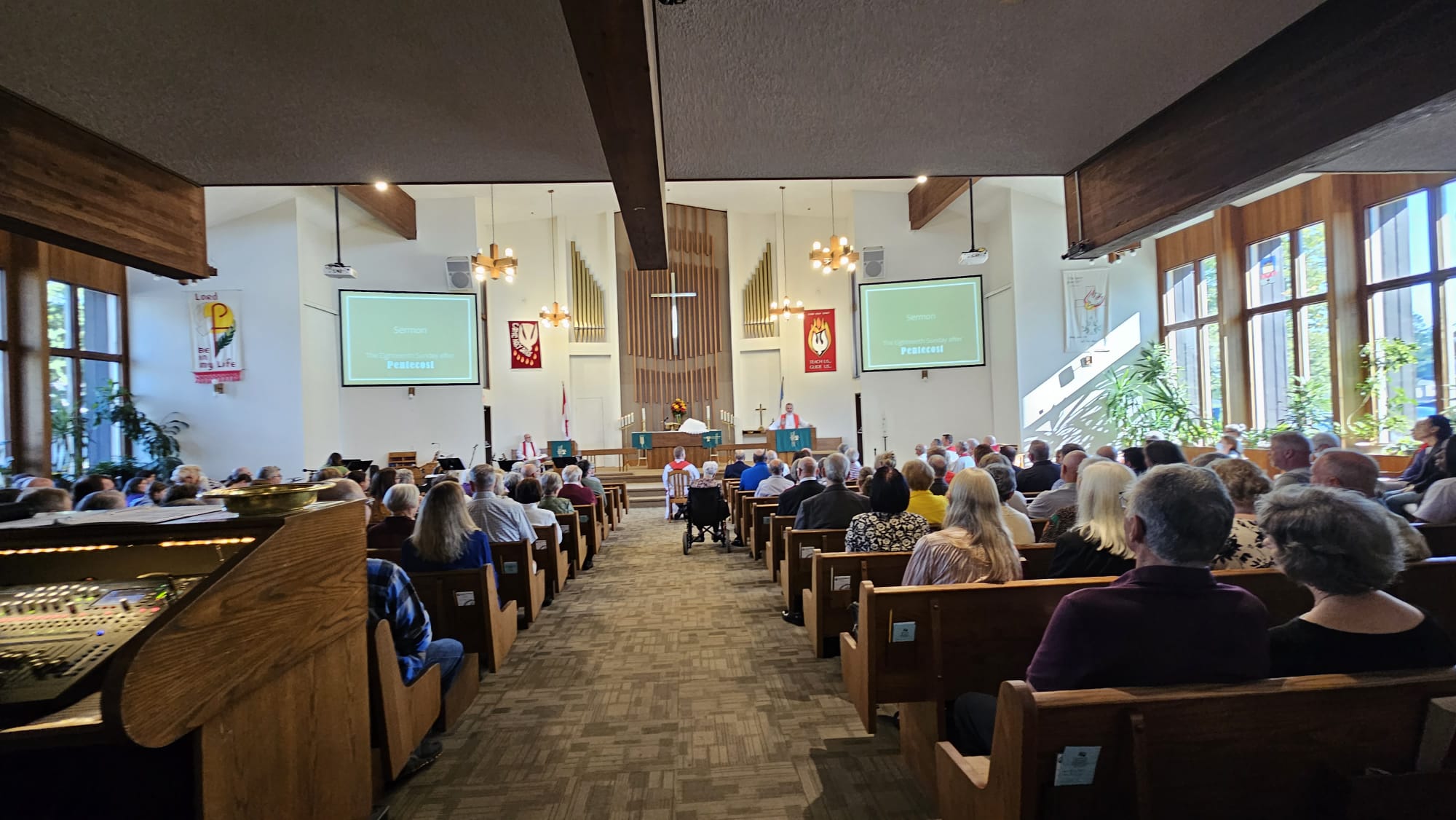

Sermon – March 22nd, 2026
Hope Lutheran Church, Port Coquitlam BC
Romans 8:1-8; John 11
Theme: “A pleasant life”
____________________________
Intr – In my sermon today I decided I wanted to please you all. I made my best guess — here’s what I came up with:
A broom — for the women present today. I love cleaning the house every other week, so I thought that you would too.
A soccer ticket — for the men with us. I love soccer, it’s so much fun.
An introduction to the Old Testament — for all who love reading. I love reading theology, so I thought you’d enjoy it.
The biography of Paul Gerhardt — for our musicians. I love the history of Lutheran composers, so I thought you’d love it.
And a chore list of 5 items — for the kids. Those are chores I think are important, so I’m sure the kids will agree.
How’s that? Do you think I would succeed?
Of course not. And did you notice something? Every single time I said: “since I love it, I thought you would too.” I made it all about me. I don’t actually know you well enough to know what would make you happy. I would have needed to stop making it about me — and start making it about you. To actually know you.
Because here’s the truth: If you don’t know the person well, you don’t know how to please them correctly.
1 – Whom to please?
In life sometimes we want or need to please people around us. And we usually know different ways to please different people in different contexts. For example: our Boss, our Parents, our Children, our Friends… In doing so, we try to figure out what in their perception will be perceived as appreciation, not just what we would appreciate in their place. Sometimes is easy; sometimes is tricky. But we will usually look through their lenses to find the best option.
When it comes to pleasing God though, we don’t always get that right. If you wanted to please God, you would probably do the same – you’d ask, “what is it that is God pleasing?” Now, we can only know how to please God if He know him well. That’s why some of the things we may try may not land as we intended.
Here’s one of the classics: “I don’t kill and I don’t steal, and I pay all my debts, so that should be enough to get me to heaven.” Or we try to be nice and good, at least when people are looking. Or we allow ourselves to get into situations and attitudes that would are disconnected from our values. Or we latch on to every single new wave of morals and ethics because it seems to be the right thing to do.
How can we please the Lord if we don’t really dive deep into what pleases him?
But here is what Paul wants us to understand: this isn’t simply a knowledge problem. It’s not that we just need better information about God’s preferences. The issue runs deeper than that. Flesh and Spirit are not just two different sets of behaviours — they are two fundamentally different orientations of the self. The mind set on the flesh, Paul says, is hostile to God. It cannot submit. You cannot think or try or discipline your way out of that. The flesh-mind is hostile and cannot submit (Rom 8.7) — this explains why law alone fails. We couldn’t find our way out — so God had to act (Rom 8.3). And that is what makes grace not merely convenient, but astonishing.
2 – God is pleased with us
There is something else to be considered here. What would happen if God waited to be pleased with us first, in order to be pleased to be favorable towards us only after that? The answer is: nothing. Not even all the gold and diamonds in the world would pull that trick.
Which is exactly why God didn’t send a better rulebook. He sent his Son.
Then, Paul says there is no Condemnation for those in Jesus. Think about what condemnation actually feels like. It’s that voice — the one that shows up in the quiet moments — that says: you are not enough. You keep failing. God must be tired of you. Maybe you’ve heard it after a hard conversation with your spouse. Maybe it comes when you remember something you did years ago that you can’t seem to put down. Condemnation is heavy. It follows you.
And Paul opens chapter 8 with the most extraordinary word in response to it: therefore. Everything he has argued for seven chapters — the reality of sin, the failure of the law to fix us, the desperate need for rescue — all of it comes to a point right here. There is therefore now no condemnation for those who are in Christ Jesus. Not: condemnation is reduced. Not: condemnation is manageable. No condemnation. None. And notice the word now — this is not a verdict waiting to be delivered at the end. It has already been rendered. In Christ, the case is closed. The verdict is already in
He saw our sinful condition and decided to come to meet us where we are. In the epistle to Romans that we heard today we learn that Christ took on human form to do what we could never do. In his cross and resurrection, He:
_swept away all condemnation from our lives;
_knitted together our hearts broken by sin and made us children of God;
-Gave us his Spirit to empower us to live our faith;
-Our lives are faith filled and God directed.
He did this work of love so that everyone, each human being without exception, could be offered this unfathomable love for their lives. When we are in faith in Him, we are free from condemnation. We are at peace with God, living as children. Now we can live a pleasant life before Him. A life of those who do not seek to save themselves, but to put their trust and hope in Him, and whose lives will then reflect this salvation in daily life.
God is not pleased at our hands first. He is pleased at our hearts — and he gets there through Jesus.
Paul is clear: we cannot please God with gifts of the flesh. There is nothing in our words, thoughts and deeds that can make us worthy of anything before God. This is why it is important to look at our lives and fight the inclinations that lead us the wrong way. We can only please God when we live in the Spirit.
3 – Pleasing God
“But pastor, does it mean pleasing God is completely off the table?”
It is not. We heard that last Sunday, remember “What is pleasing to God”. Once we know that God is pleased at us in Jesus, we will strive for a life pleasing to Him. And what makes this possible is Spirit. The law of the Spirit of life has set you free. The Spirit is not just an idea — it is power and movement.[1]
The Spirit is not just an idea, but power and movement, The Holy Spirit of God guides you and empowers you.
-Light, not darkness
-Love, not indifference
-Real, not performed
It is Spirit, not flesh. Fruit not chores. For example:
- When you forgive and refuse to join the pile-on, even when everyone else is.
- When you listen before passing judgement
- When you admit you were wrong — to your spouse, kids, colleague…
- When you serve without needing the credit
- When you stick to the Word even when the World disagrees.
- When you bring your offering even when the economy is scary.
- When you rest — really rest in a world full of occupation and distraction.
- When you bless someone who just got what you wanted.
- When you keep your word even when keeping it costs you
- When you continue to live in hope even if everything around you seems to point otherwise – because your Hope is a Person: Jesus. [2]
I know, I’m being very specific here. I wanted to be real-life like. However, this is not a checklist, a score card; this is not finger pointing. They are fruits, not chores. They are the fruit of a life that knows God intimately — the same way you naturally know how to make your closest friend smile, not because you memorized a list, but because you know them.
We heard last Sunday Paul asking is to seek “What is pleasing to God.”(Ephesians 5) Today we see the foundation beneath that answer. You can only live a life pleasing to God when you know him — and you know him because he first made himself known to you, in Jesus, in Baptism, in the Word, at this Table.
This is Grace. This is Love. This is Life.
Conclusion – Why does it matter to live this pleasant life — a life that shows the fruits of faith in Jesus? Because real works are fruits of real faith.
And then we look to the Gospel today to understand why real faith matters. John, reporting the episode of Lazarus in Chapter 11, answers us plainly: life doesn’t end here. Whoever believes in Jesus, even if he dies, he will live — forever. We live in Christ and we die in him. And then we will dwell in the most pleasant place there is: the House of the Lord
____________________________
[1] The Spirit is not a reward for doing well. The Spirit is not a feeling you get when the worship music is particularly good. Paul says the law of the Spirit of life has set you free. The Spirit is the active, living power of God working in you right now — not waiting for you to be ready, not standing by while you try harder. When you forgive someone who doesn’t deserve it, that is not you being a better person. That is the Spirit moving. When you hold your tongue, when you sit with someone in their grief, when you tell the truth at personal cost — that is not willpower. That is the Spirit at work in a life that belongs to God. This is why the list I’m about to give you is not a checklist. You don’t do these things to earn anything. They are what a Spirit-filled life looks like from the outside.
[2] When Sunday morning wins over Sunday sports
When you admit you don’t have it all together — and say so out loud
When you pray for the person you just saw dragged on social media
When you show up for someone who has nothing to offer you in return.
When you stay faithful in the small things, when no one is watching and nothing feels significant.
When you hold your tongue, even though you had every right to speak