Text: Matthew 1:18-25
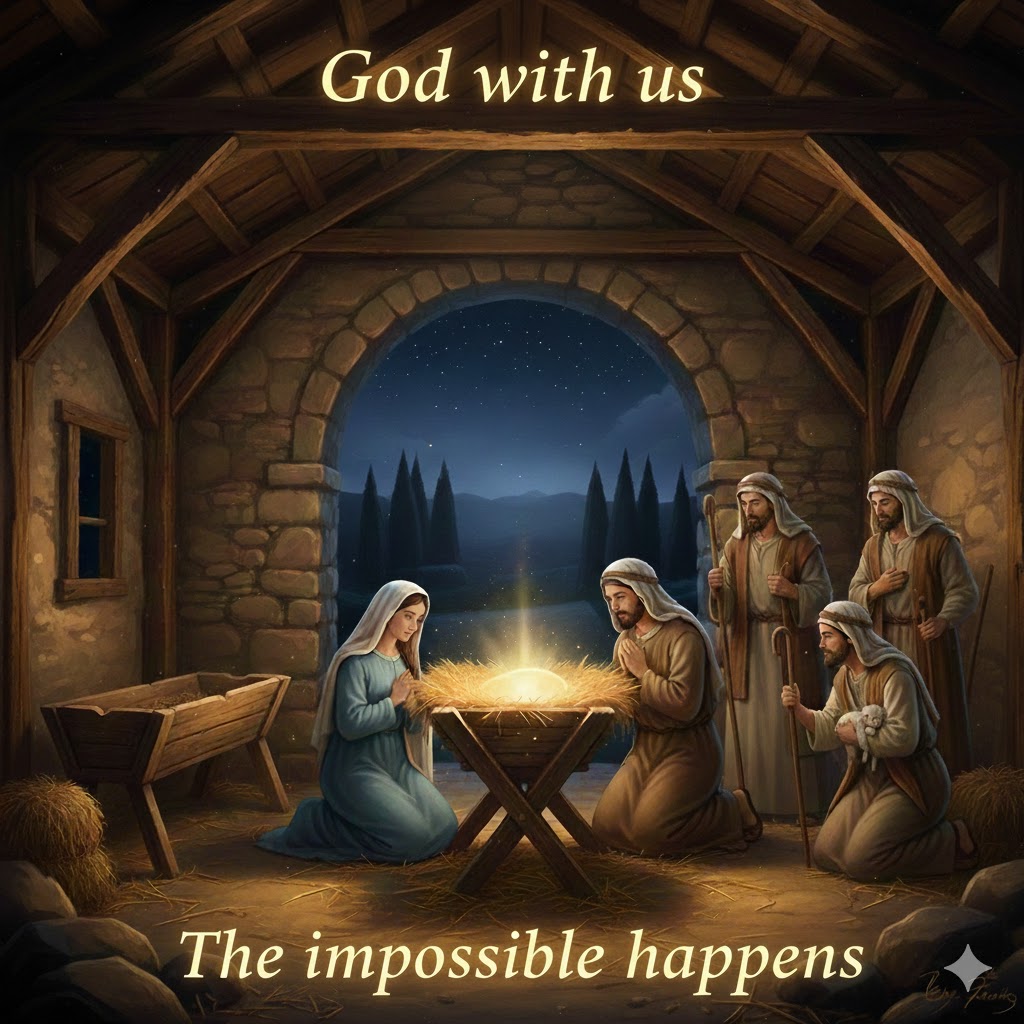
Theme: “God with us – the impossible happens”
Rev. Lucas Albrecht
___________________________
Intr – I have with me here a sheet of paper. And a question for you: How could you go through this sheet of paper with your entire body? Is it possible? Would you have any clue how to do it?
Think about it for a moment. A 260lb guy like me—or anyone here—passing their whole body through this little paper sheet. The verdict seems clear: impossible.
(Im)possible?
And that word—impossible—fits Christmas rather well, at least from a human point of view. Think about it. Angels appearing to frightened shepherds, stars guiding wise men across deserts, a virgin conceiving a child, God Himself becoming a baby—these things feel… difficult. Our of the realm of possible. [1]
Those things seem so impossible that the temptation is big to remain in the realm of the “possible”: lights, good tidings, family, decorations, love, joy, and peace. All of those are good and are part of our Christmas tradition. But if we stop there, we will miss out. If we settle for the possible, we will be missing the beauty, depth, and reality of the impossible of Christmas.
Joseph’s dilemma
Impossible. Listen to what Matthew tells us: “Now the birth of Jesus Christ took place in this way. When his mother Mary had been betrothed to Joseph, before they came together she was found to be with child from the Holy Spirit. And her husband Joseph, being a just man and unwilling to put her to shame, resolved to divorce her quietly.” (Matthew 1:18-19)
Put yourself in Joseph’s sandals for a moment. You’re engaged to Mary. Everything is planned. Your future is set. And then—she’s pregnant. Not by you.
The situation is impossible. There’s no good outcome here. If he accuses her publicly, she could be stoned. If he marries her, everyone will count the months and assume the worst about both of them. If he quietly divorces her, she’ll be shamed and destitute.
Joseph is a just man facing an impossible situation. What can he possibly do?
That’s when God speaks: “But as he considered these things, behold, an angel of the Lord appeared to him in a dream, saying, ‘Joseph, son of David, do not fear to take Mary as your wife, for that which is conceived in her is from the Holy Spirit. She will bear a son, and you shall call his name Jesus, for he will save his people from their sins.'” (Matthew 1:20-21)
And then Matthew gives us the key to understanding everything: “All this took place to fulfill what the Lord had spoken by the prophet: ‘Behold, the virgin shall conceive and bear a son, and they shall call his name Immanuel’ (which means, God with us).” (Matthew 1:22-23)
The impossible happens
Then the impossible happens. For this is what Christmas is: the Feast of the Impossible. Here are some of the impossible features of this story:
The mother—pregnant while still a virgin.[2]
The father—a man who chose trust over suspicion, obedience over self-protection.
The King—born not in a palace but in a stable, laid in a feeding trough.
The announcement—delivered not to rulers but to shepherds by angels breaking through the night sky.
The worship—offered first by shepherds, the lowest and the outsiders. And then from men from a faraway land guided by as start to the baby’s house.
These are not metaphors. They are facts. The Son of God took on flesh in time and space. He lived in time and space. He died in time and space. And He saved us—in time and space.[3]
Impossible for us. Entirely possible for God.[4]
However, the most incredible, impossible thing the baby in the manger comes for is: to overcome sin and death. Something completely impossible for us. However, Christmas tells us that the impossible is no more. Sin has a solution and the Father makes it happen. Jesus takes on human form and dwells among us. In that rough manger lies the child who will grow to manhood, who will carry a cross up Golgotha’s hill, who will cry out “It is finished” and mean it—our salvation accomplished, our redemption complete, our impossible reconciliation with God made real.
Think about this: God with us. Heaven comes close to earth, so much so that even angels are around. Whenever we think of being closer to God, the answer is only one: Jesus. The impossible becomes real.[5]
(Im)possible in daily life
This impossible-made-possible Christmas meets us in our impossibilities. That means there is hope for you and I.
Perhaps we are that person in the middle of something happening in life that seems impossible. I speak less of material problems, which can surely be big problems too, but especially emotional, spiritual ones. It may be melancholy, anxiety, grief or sorrow. It may be guilt – you keep doing things you know you shouldn’t. On the other hand, it can be expectations (too high), strength (Too low). It may be something we don’t think it’s possible to overcome or solve. We don’t see a clue; a door, a window. Then perhaps we don’t even see Christmas as we would like it to be. There is so much pressure to be happy and in good cheers that you may feel just the other way around.
That is what you and I think. What about God – How does God see it? He sees this through Christ – which means hope and love for you. And he says, “I specialize in the impossible.” I’m not saying he will solve all the problems, but I’m definitely saying that if God made himself to fit in the smallest king size bed ever, He will be with you in all your days. The God who turned a Roman execution into the salvation of the world can redeem and strengthen you. He moves things from the “impossible” section of the human shelf to the “made possible by Christ” in God’s design.
For you may think it is impossible. But in God’s dictionary that word has a different meaning when it comes to saving, comforting, restoring and strengthening you. He did it before, He will do it again.
Cc – This is why I brought this illustration of the sheet of paper today, as a reminder that “impossible” in Biblical terms is just another way to say “God in action.” Let’s solve it now—yes, there is one way to do it. Only one way, and I’ll show you right now. (Illustration)
Two takeaways from this illustration:
First: Everyone here can go through a sheet of paper. Everyone here has access to God through faith in the Son.
Second: At the beginning, you were left with an impossible proposition. But you trusted that I probably had an answer. Impossible for you, possible for someone who knew the solution. If there is an answer to a simple human puzzle like this, how much more can we trust that God—who knows everything—has the answer to your deepest needs?
Christmas is Emmanuel. God with you. God with us. In that manger. On that cross. In that empty tomb. In your heart tonight. Christmas is the story of Christ.
The impossible that happens. For you.
___________________________________________________
[1] Perhaps that is the reason why along the way many more “rational” alternative have been front and centre us. None of them are bad, they are now a part of the Christmas tradition – the feast of a nice baby; the celebration of hope and love, respect, good cheers, and good things in life. What they do sometimes is to send to the background all those impossible stories from the Bible may sound strange or awkward to mention. We might just stick to what is plausible, attainable, possible. Sometimes “Holiday season” may become what that 80’s song says: “Hoping for the best but expecting the worst”. Sentiments are good, but we need more. We need the impossible that becomes real in time and space.
[2] As the birth of Adam was a miracle, so is Jesus’. If one denies the miracle of the creation of man and woman, one is closer to deny Christ miraculous birth as well.
[3] Christmas is not about “what matters is the message, not whether it really happened.” The message and the facts belong together. Both are crucial. The message AND the messenger the historical messenger. On that night, that year, in Palestine the Son of Man took human form. As God had done many times in the past, so He again made the impossible happen. From that rough manger the baby becomes the man that, on the cross, finished all for us. This is how he made the impossible come true. Emmanuel – God with us
[4] These are facts. Events that happened in time and space, in a real place, to real people. Impossible by human standards. Completely possible for God. It is not that “Christmas isn’t about whether these things really happened. It’s about the message—peace, love, hope.” But the message and the facts cannot be separated. If this is only a story, only a frame of mind, then it’s just another impossible dream we’re asked to believe in.
This is how we want to keep it right as it is: the Feast of the Impossible that happens. Christmas involves presents, good cheers, family, joy and celebration. That is all good tradition. But Christmas tells us far more: that the impossible is no more. But if God truly became flesh—if the eternal Word truly took on human form in time and space—then the impossible has actually happened. And that changes everything.
[5]This is the impossible story that went the world ‘round. Christmas is the Feast of Faith, the Banquet of Believing. The celebration of the impossible.